

Since 2017 I’ve published the books I read over the previous 12 months, along with a few I intend to read over the next year. This began on LinkedIn but moved to Substack when I published Last Years List.
By popular request, I’m releasing it earlier this year to give people a chance to buy some of these books before the holidays. Whether you know me from Substack, LinkedIn, or don’t, it should be apparent I enjoy reading on a variety of subjects, but they usually fall under one of these categories: finance/economics, history, productivity, health, and psychology, with some fiction thrown in. The same subjects I discuss on Serviceable Insights, funny how that happens.
Instead of combing through 8 years worth of posts, I created a Notion page with a Running List of Books From Previous Years. Check it out if you haven’t already.
If you want a bit of a description of each, I have a consolidated list in a Substack post for 2017-2023 (my apologies for the length & formatting).
For this year’s edition, I’ll include a short description of each book, along with my views and any associated articles I published related to them.
Keep reading if you want to inspiration for books to read in the upcoming year!
But first, make sure to hit the Subscribe button to join 1,000+ other Subscribers that get Serviceable Insights delivered directly to their inbox each week.
If this week’s article does not interest you, please check out some other recent ones:


2025 Reading List
I’ve read 12 books so far and expect to finish another two or three before year-end. This is in line with other years and excludes books I started but didn’t finish.
The list contains a bit more fiction but otherwise is pretty consistent with other years with the exception of the absence of health/fitness titles this year; I got my fix doing research for my article on creatine. I haven’t come across any interesting ones lately but perhaps that will change in 2025 (send recommendations if you have them).
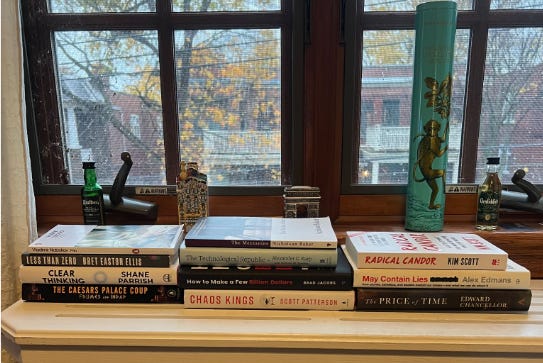
Without further ado, here is the list.
The Mezzanine by Nicholson Baker
Rating: 70/100 (I would neither recommend no dissuade)
Baker manages to make a journey up and down an escalator last over 100 pages, incredible from a stylistic standpoint. Fairly niche as a book, Baker isn’t the first to attempt this, but you need to be in the right mindset to get through a novel where nothing really happens. I enjoyed it, but if you’re looking for a page-turner, this isn’t it. I wouldn’t rate it higher because I don’t expect I’ll read it again, and I’d only suggest it for very avid readers, English-major types, or people who read James Joyce by choice.
The Castle by Franz Kafka
Rating: 80/100 (I would recommend if asked)
After thoroughly enjoying The Trial and The Metamorphosis, this one didn’t disappoint either. The Castle tells the story of a land surveyor’s efforts to reach the Castle in the town he was hired to survey. As you’d expect, in true Kafkaesque fashion, the task is anything but straightforward.
It’s slightly more difficult to read than the other two mentioned above but nonetheless an all-time classic. Anyone who has ever had to navigate bureaucracy will relate to it.
Not specifically about The Castle but my most relevant article from 2025 was How Society Uses Bureaucracy to Keep You Safe but Miserable)
How To Make A Few Billion Dollars by Brad Jacobs
Rating: 75/100 (Would recommend but not insist)
After listening to Jacobs appearance on the Knowledge Podcast, and hearing great things about his fireside chat with Paul Desmarais III, I decided to buy his book. If you don’t know who Brad Jacobs is, you should. He’s scaled several businesses in different industries to multi-billion dollar market caps. Few outside of Elon Musk can make that claim.
The book itself is decent, though he performs better in podcasts discussing it. His charisma gets slightly lost in translation. I like Jacobs, so let’s blame his editors. If you don’t want to get the book, at least check out a few of his discussions. If you’re too lazy or time-pressed even for that, here’s an ultra-reductionist formula for making a few billion dollars: as a CEO or business owner, you need to
(1) identify, attract, and retain the absolute most talented people you can; and
(2) aggressively leverage technology, ideally in industries where others are not.
Chaos Kings: How Wall Street Traders Make Billions in the New Age of Crisis by Scott Patterson
Rating: 80/100 (I would recommend if asked)
Many are familiar with Nassim Taleb because of the success of his books The Black Swan, Fooled by Randomness, and Antifragile, among others. Before his writing days, he was a trader, a successful one. As his interests shifted to writing and teaching, he did less trading but co-founded a hedge fund with Mark Spitznagel called Universa.
While Taleb eventually reduced his day-to-day involvement, Universa’s trading strategies maintained many of the principles he’s written about, producing spectacular returns uncorrelated with other top strategies. The audience for this book is fairly narrow: likely someone who has read Taleb’s other work, has a solid understanding of finance, and wants to read about internal politics at major pension funds. That probably leaves just me. I enjoyed it, but I can’t promise the same experience for everyone.
Clear Thinking: Turning Ordinary Moments Into Extraordinary Results by Shane Parrish* (Re-Read)
Rating: 90/100 (I would actively recommend)
With my bookshelves overflowing with unread options, if I choose to re-read something, it’s a pretty strong endorsement. In this case, I recommended Clear Thinking for a book club at my company. As the moderator, I needed to prepare for the discussions, I summarized my notes in two articles which you can check out here (Articles 1 and 2).
Parrish is the founder of the popular website Farnham Street and the Youtube Channel The Knowledge Project.His subscribers number in the millions, and for good reason. He’s been sharing insights on mental models, decision-making, and learning for over a decade. Clear Thinking doesn’t disappoint if you want to deepen your understanding of those topics.
Rating: 90/100 (I would actively recommend)
I wrote about this just the other week (check that out here). This is a great book for people interested in the behind-the-scenes world of private equity, debt capital markets, and bankruptcy court. Think of it as a modern Barbarians at the Gate without the hype.
For those unfamiliar with finance, it might feel dense at times, but that’s secondary. The drama between the finance heavyweights is as interesting as Apollo’s financial engineering.
Less Than Zero by Bret Easton Elis
Rating: 80/100 (I would recommend if asked)
Ellis, the author of American Psycho, published Less Than Zero at just 21 years old. While not an uplifting story, his ability to capture and subtly satirize wealthy LA teenagers in the 1980s is brilliant. Much of the criticism seems to come from readers who missed that Ellis was mocking this lifestyle. I’d consider it an accessible fiction pick for those who don’t typically enjoy novels, but if you’re looking for a feel-good story or lots of action, I’d look elsewhere.
The Price of Time: The Real Story of Interest by Edward Chancellor
Rating: 90/100 (I would actively recommend)
This was the best book I read this year. Chancellor’s deep dive into the history and economic ramifications of interest rates does a better job of explaining monetary theory than many economics degrees. His rigorous work shows how prolonged, artificially low interest rates are a key factor in economic bubbles.
The first 100 pages serve as a great history of monetary systems and financial collapses. You don’t need an economics background to enjoy it. The later sections are more technical, but if you’re vaguely familiar with economic principles or willing to spend some time with Chat or Claude, it’s worth the investment.
(My Article Nobody Understands Interest Rates summarizing some of the concepts)

The Technological Republic: Hard Power, Soft Belief, and the Future of the West by Alex Karp
Rating: 70/100 (Would not actively recommend or dissuade)
Karp is the Founder and Active CEO of Palantir. After operating in relative obscurity in the early years, Palantir has gradually risen in prominence as they’ve become an increasingly important part of the national security apparatus in many major countries. Their stock PLTR 0.00%↑ has been a meme stock with monstrous returns, that continues to trade at sky high multiples.
As Palantir’s prominence grew, Karp became more outspoken. The Technological Republic recaps many of his public remarks, mainly that Silicon Valley’s reluctance to produce technology for the military weakens the West. He argues technologists have a moral imperative to work with the military.
Realistically, his views could have been summarized in a few pages. The anecdotes are interesting, but the book drags; his charisma comes across better in interviews (many are on YouTube). You’ll get 80 to 90 percent of the takeaways from one of those.
(See my article Is Alex Karp a Kafka or Dostoevsky Character?)
Rating: 85/100 (I would actively recommend)
This is next week’s article, so I will hold off on the summary for now but it’s worth checking out. Very good discussion how to separate fact from fiction. The best book on the subject since Thinking Fast & Slow, The Signal and The Noise or Thinking in Bets.
Edmans, a finance professor at London Business School, examines how statistics, academic research, and media narratives can be manipulated, showing readers how to identify misleading claims and think more critically about data.
Link to article will go here.
Radical Candor: Be a Kick-Ass Boss Without Losing Your Humanity by Kim Scott
Rating: 70/100 (Would not actively recommend or dissuade)
I have a half finished draft on this to be released at a later point.
Scott, formerly of Google and Apple, outlines a framework for giving feedback that balances personal care with direct honesty, aimed at helping leaders build more open and effective workplace cultures.
Rating: 75/100 (Would not actively recommend or dissuade)
What’s considered to be Nabokov’s most approachable work, the semi-autobiographical tale follows Professor Timofey Pnin, an exiled academic teaching at a small American college, whose social awkwardness and nostalgia for his homeland create both humor and quiet tragedy.

Books in The Reading Queue
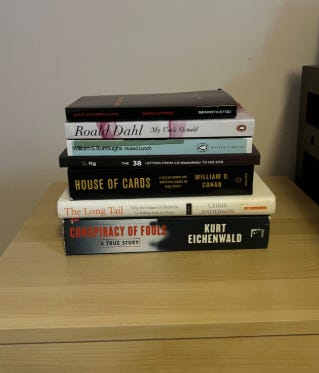
Simulacra and Simulation by Jean Baudrillard
A philosophical treatise exploring how modern society has replaced reality with symbols and models, leading to a world of “simulacra” where representation becomes more real than the real thing. Famously, this book inspired The Matrix franchise.
My Uncle Oswald by Ronald Dahl
A comic, risqué novel about the adventures of Oswald Hendryks Cornelius, a wealthy and scheming bon vivant who sets out to build a fortune by exploiting the libidos of famous men. It’s Dahl’s most adult and mischievous work.
Naked Lunch by William S. Burroughs
A surreal, nonlinear novel that blends drug hallucinations, social satire, and grotesque imagery as it follows addict William Lee through a series of disturbing vignettes. It became a defining work of the Beat Generation and a landmark in experimental literature.
The 38 Letters from J.D. Rockefeller to His Son by John D. Rockefeller
A collection of personal letters written by the oil magnate to his son, offering guidance on business ethics, philanthropy, and personal conduct. The correspondence reveals Rockefeller’s views on success, discipline, and moral responsibility.
House of Cards: A Tale of Hubris and Wretched Excess On Wall Street by William D. Cohan
A detailed chronicle of the 2008 collapse of Bear Stearns, examining how arrogance, greed, and mismanagement brought down one of Wall Street’s most storied investment banks. Cohan draws on insider accounts to capture the drama and dysfunction of the era.
The Long Tail: Why the Future of Business Is Selling Less of More by Chris Anderson
Explains how digital marketplaces and distribution networks have shifted business models from mass hits to niche products, showing that profitability now lies in catering to the “long tail” of specialized consumer demand. A foundational text in internet-era economics.
Conspiracy of Fools by Kurt Eichenwald
A fast-paced narrative recounting the rise and spectacular fall of Enron, tracing the hubris, deception, and accounting fraud that led to one of the largest corporate scandals in history. Reads like a thriller but remains meticulously sourced.
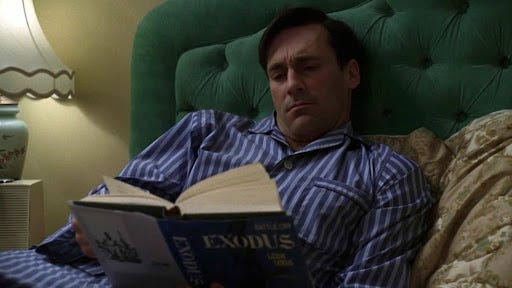
I hope you find some inspiration from all of these titles, I look forward to checking in with you next year with the books I read in 2026 and other titles I’m looking at for 2027. Happy reading!
Thank you for reading. If you liked this article please Subscribe below. I publish articles on a wide range of topics from business, books, current events or anything on my mind.
Wide ranging intellectual curiosity! Going for the price of time first on your recommendation