

There I was in the tunnel surrounded by 20 mostly shirtless dudes. Loud EDM was blasting. People were cheering. Was I at Coachella? Ultra? An underground nightclub?
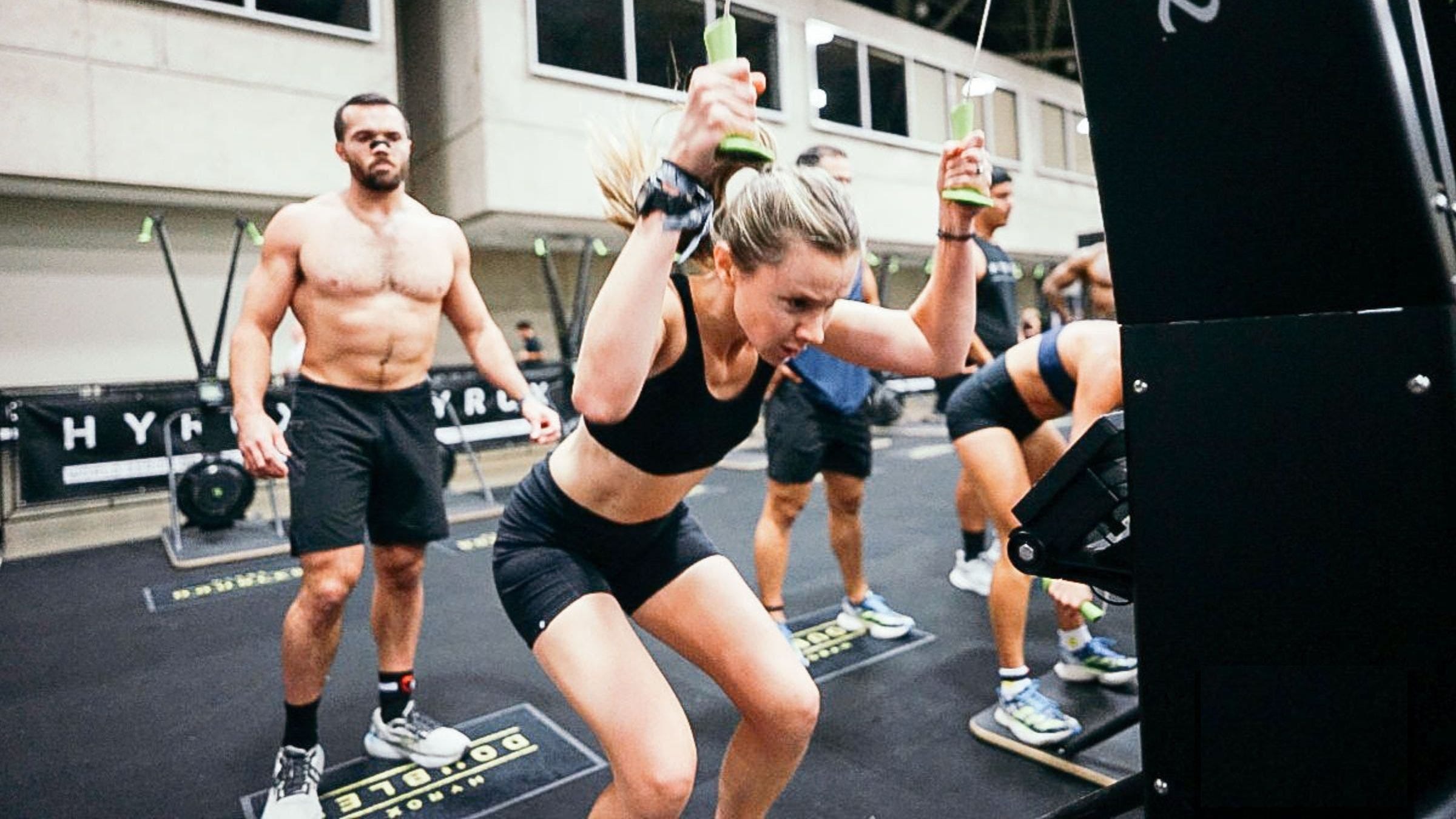
No. I was in an abandoned airport hangar on the outskirts of Berlin about to run 8 kilometers with eight exercise stations mixed in. I was doing this alongside my buddy with whom I could split the stations as we wanted but we both had to run the full distance.
We were about to compete in what’s called HYROX. Some people claim it’s short for Hybrid Rockstar, but thankfully that’s not been sanctioned by the organizers.
The confusion is natural. HYROX is geared towards hybrid athletes, people who can run and lift weights. The type that go to run clubs/Barry’s Bootcamp but also have a gym membership. You can usually spot a HYROX athlete from a distance. They are wearing unnecessarily expensive gear and spend as much time documenting or tracking the workout as they do completing it.
Although to an outsider this might appear cringe, you need to do some combination of this or you’re going to struggle. Although I’m skeptical of the HYROX crowd’s belief that colour coordinated sports bras and short cut 10% off their time.
In any case, there we were: a leading venture capitalist and a burgeoning Substack writer preparing to suffer for the next hour.
This is the story of how our race unfolded, what I learned from the experience, and how HYROX went from relative obscurity to a global fitness phenomenon.
Keep reading to find out.
Book I’m Currently Reading:
Devil Take the Hindmost: A History of Financial Speculation by Edward Chancellor
Book Worth Re-Reading:
So Good They Can’t Ignore You by Calvin Newport
In case you missed them, here are some other recent articles to check out:



How The Race Went
It took us 70 minutes to complete the race, which placed us ~100th out of 300 teams that participated in the Open Doubles Race that day in Berlin. For a first time effort that’s considered good. Experience helps in races like these. We got two time penalties of one minute each, registering our official time at 1:12. The winning team did it in ~53 minutes, another 19 did it in under an hour. The difference between 50th and 100th place was a couple of minutes. Most teams did it somewhere between 1:15-1:20. A bunch couldn’t finish, due to injury or cramping.
We spent 34 minutes on the runs which put is in the middle of the field. We started off strong but I started cramping up after the 3rd station, which slowed us down considerably. My partner was finishing almost a minute faster than me on some runs, but since he had to wait it didn't matter. Our two penalties came because he crossed the run exit sign too far ahead of me. He was waiting for me in front of the entrance to the station, so we didn’t get any advantage. HYROX is full of little rules like these that we weren’t aware of.
Our 34 minutes of run time, only measures the time spent in the run zone. These aren’t actually a kilometer long, but closer to 750-800M. This is the distance between the entrance and exit signs you see as you enter or exit the Roxzone. The Roxzone is considered its own area, between the runs and the stations. The total Roxzone distance is somewhere between 250-350M. We spent 13 minutes there, which is also middle of the pack. Mostly because we stopped for water and walked for parts of it. This is a race so every second adds up fast.
We started strong on the stations. We did the 1000M Ski ERG in 3:51, the 65th best time. 1:44 for the 50M Sled Push (83rd place). Once the cramping started, we began moving slower to the stations which count towards your time. My teammate had to pick up more slack for me from the 4th station onwards, so we fell from the top quartile to closer to an average time. For most stations, the difference between top quartile and the mean is about ten seconds. Far less consequential compared to the runs and Roxzone.
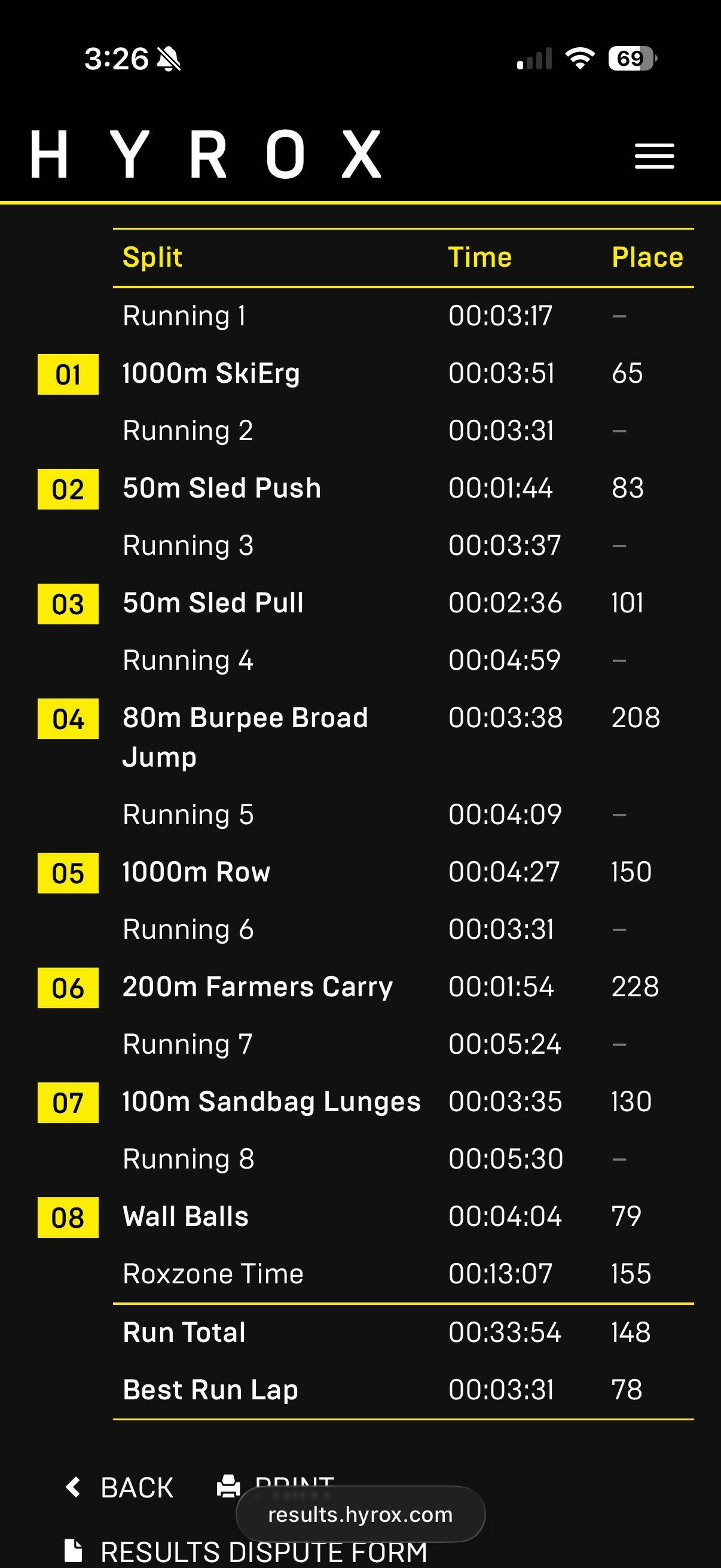
This is why as much as it’s a hybrid athlete race, the key determinant of the finishing time comes down to running.
In my case I didn’t do enough of it. The three week trip to Japan 6 weeks before, was a setback, but it could have been negated. I was running at the pace I wanted on the treadmill with relative ease, but at a HYROX you aren’t just running 1KM then doing a station, before running another KM. You have to sprint an extra 100-200M before the station, then again before starting the next run. This quickly adds up and over the course of the race, you do closer to 9.5KM.
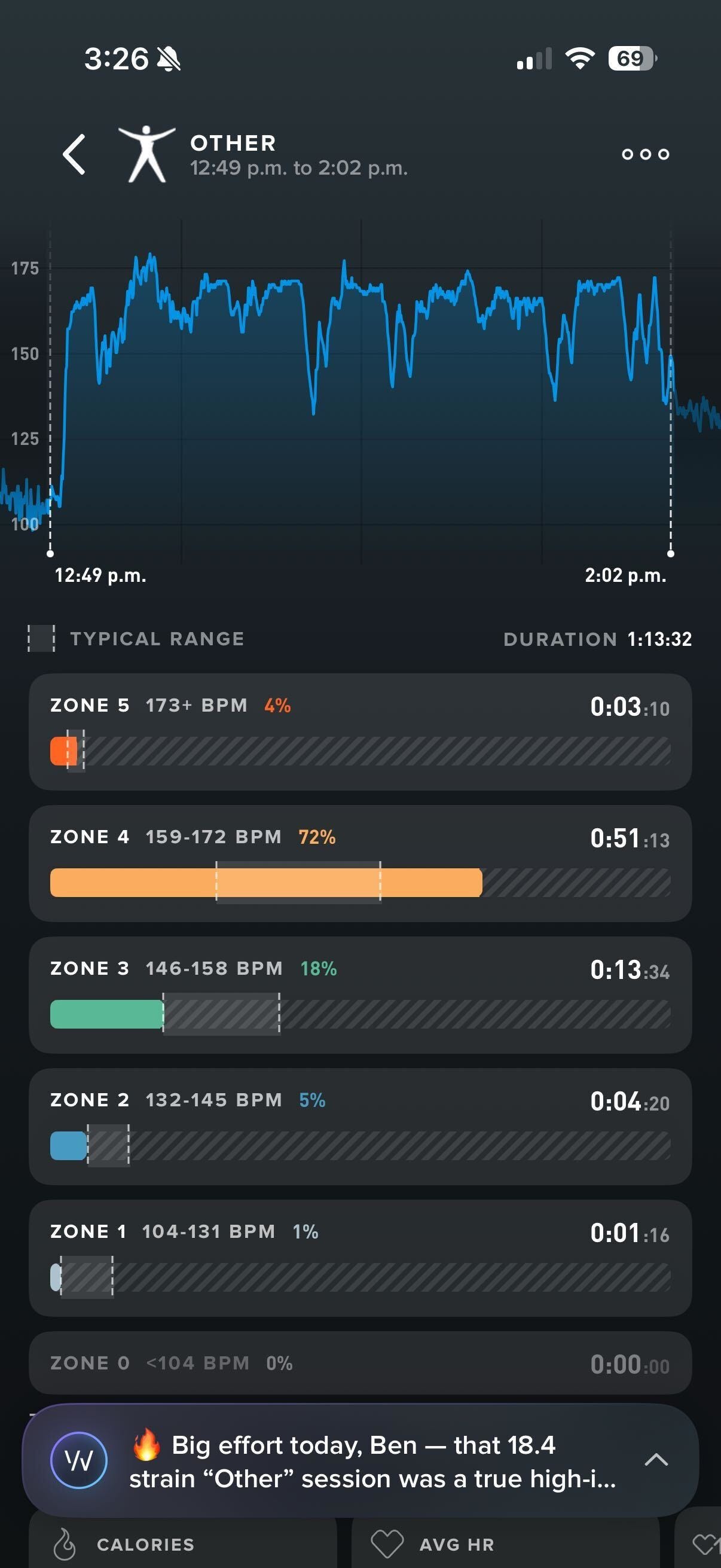
This wasn’t a case of gassing out, I spent almost the entire race in Zone 4 and barely entered Zone 5. This was a different feeling. I was never breathing super hard, this was simply my body refusing to push faster. It was smart enough to slow down to prevent cramping. Not everyone was so lucky. There were several teams collapsed along the track, with medics or teammates trying to rub out hamstring or calf cramps. Fortunately, I was able to avoid those until the very second the race ended.
If I could redo it, I would train to run for an hour straight at a slightly faster pace than what I would want to run for the HYROX. When you factor in the fatigue from the stations, you are going to run a bit slower. If the goal is to do the runs + Roxzone at an average pace of 4 mins per KM, I would train to run for an hour at 3:50.
I’m confident without cramping and better preparation, we could easily shave at least 5 minutes off our time. I’m certain we will do one again, because the HYROX environment is set up in such a way that the second you finish, you can’t wait until your next one. That’s why HYROX has achieved the scale it has so quickly.
A Brief History of HYROX
HYROX was founded in Germany by Christian Toetzke and Moritz Fürste in 2017. Toetzke had experience organizing sporting events such as running, cycling and triathlon races. Fürste was a former German field hockey star who won two Olympic gold medals.
They identified a gap in the fitness market. Millions of people go to the gym as their primary form of exercise, but they didn’t have a good event to compete in. Runners have marathons, cyclists had road races, weightlifters have power lifting competitions. The closest thing to a holistic fitness competition was CrossFit.
CrossFit got pretty big in the early 2010s but as a competition, it’s not accessible for most gym goers. Outside of professionals, few can master all the techniques required for the Olympic lifts and gymnastics to qualify for a CrossFit competition. Even if you are in good shape, if you draw a workout with exercises you aren’t good at, you’ll have a tough time being competitive.
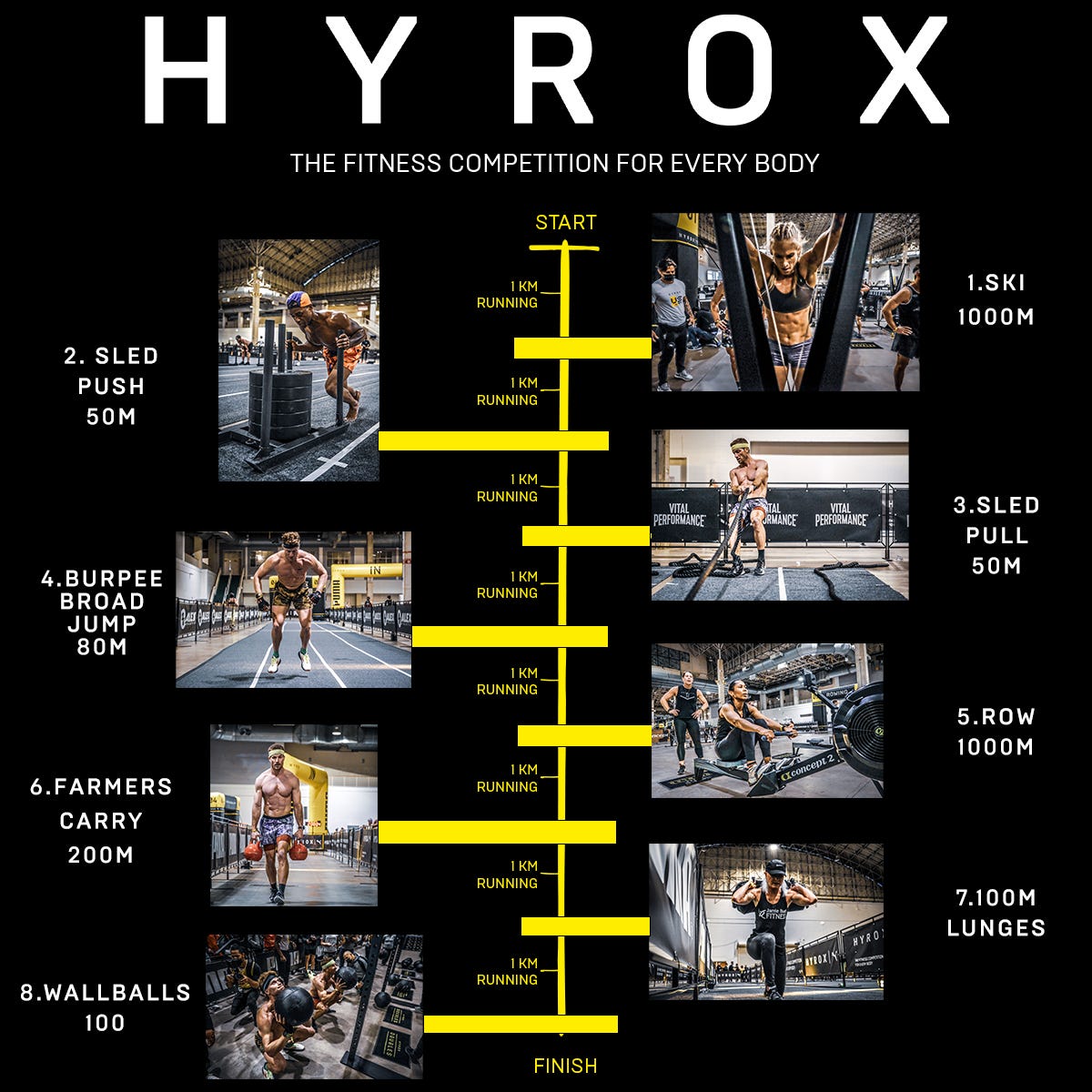
HYROX eliminates the variance and luck of the draw by designing each race in the same format. The movements are comparatively less technical. There are optimizations, but anyone can push a sled or use a rowing machine with minimal instruction. Handstand pushups and backflips are harder to learn.
700 people competed in the first HYROX event in Hamburg 2018. The vision was to create something resembling a marathon. Where elite athletes or first-time amateurs can do the same workout, just in different times. Since the race format is standardized, participants across cities and seasons can compare their times.
The company’s expansion accelerated after a sports marketing group Infront made an initial investment in 2019. They would later become the majority owner in 2022. Infront is owned by China’s Wanda Group, but HYROX’s founders continue to own a stake and operate the business.
Since the ownership change, HYROX’s growth has been spectacular. They had 90K athletes compete during its 22–23 season. In 2024, this grew to 325K across 60 events. There are 100+ events and >1.5 million athletes expected for the current 25-26 season. They offer the race in several formats. You can compete as an individual or as a team, in the Pro or Open format. The difference comes down to the weight on the sled, lunges and farmer carries (we did the Open).
There is no reason to expect this growth will slow down any time soon. No matter how many HYROX events they add, most sell out months in advance. The number of HYROX specific gyms have doubled in the past year but seemingly most people still haven’t heard about it.
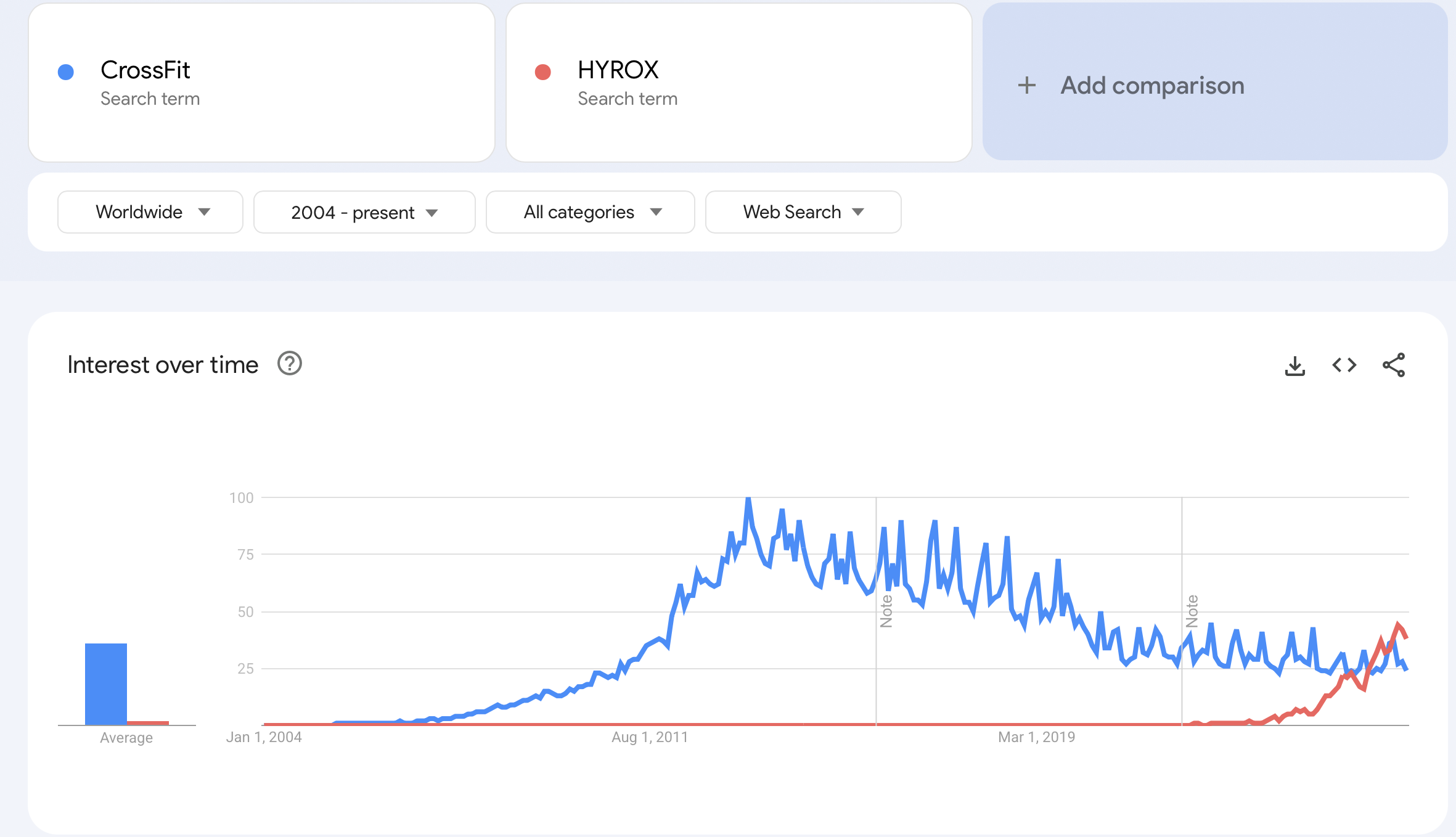
At its 2018 peak, somewhere between 2-5 million people participated in CrossFit, across 15,000 affiliated gyms although only ~400,000 registered for the CrossFit Open Championship. There are only around 5,000 HYROX affiliated gyms right now, but unlike CrossFit, most HYROX participants don’t train at one of these affiliates.
We are nowhere near peak HYROX. A greater percentage of participants can compete in HYROX compared to CrossFit and HYROX hasn’t come close to reaching the same culture awareness that Peak CrossFit did.
Final Observations
The fitness and fashion industries have a lot in common. New concepts can come and go quickly, and there is a lot of competition for mindshare. Both industries are massive but there’s plenty of competition. Some brands or sporting events can endure decades to centuries, whether that’s Ralph Lauren, Rolex or running a Marathon.
HYROX has been on a great run these past years, but many fitness concepts got big then ran out of steam. Do you know anyone that has done a Spartan Race or Tough Mudder lately? I’m sure a decent number of readers don’t even know what those are.
HYROX has a lot of momentum but if they want to become a mainstream sporting event staple like a Marathon or Triathlon and not a passing fad, they need to strike the right balance between accessibility and difficulty. Is HYROX trying to cater to everyone or just elite Hybrid athletes?

From a business sense, these are different customer profiles. Professional marathon runners will do multiple every year and probably get sponsored, whereas the majority of participants are amateurs who will only do one or two in their lifetime.
HYROX is appealing to both groups right now but most amateurs will eventually move on to something else. Like most direct to consumer brands, churn rates are high. The number of people fit enough to run 8KM and do 8 stations in under 90 minutes is generously only in the tens of millions. Perhaps GLP-1s and Peptides will increase these numbers.
As they eventually start to saturate their core user base, they will need to decide between providing easier, watered down versions or keeping it as something intense. Many Marathon organizers offer shorter events. Half marathons, 5 or 10KM races. You can do the half Ironman as an alternative to the full, but that still requires months of preparation.
HYROX is cool right now and its participants are pretty fit. It will be fascinating to see 5-10 years from now, if this sport will remain a staple or if it will fizzle out like many concepts before them.
In the meantime, I know I’ll definitely do at least another one, and I hope you consider doing one too.
Thank you for reading. If you liked this article please Subscribe below. I publish articles on a wide range of topics from business, books, current events or anything on my mind.